Pool deck cost in St. Louis
A pool deck in the St. Louis area costs about $6–$12 per sq ft in broom-finish concrete, $9–$18 stamped, $12–$25 in pavers and $15–$35 in natural stone, installed. Most new pools include a narrow concrete band; the deck you lounge on is usually an upgrade.
- Concrete decking (broom finish)
- $6–$12 per sq ft
- Stamped or colored concrete
- $9–$18 per sq ft
- Paver decking
- $12–$25 per sq ft
- Natural stone or travertine decking
- $15–$35 per sq ft
- Already in most pool prices
- A concrete band about 3 ft wide
Pool deck cost per square foot in St. Louis
| Material | Installed, per sq ft | What to know |
|---|---|---|
| Broom-finish concrete | $6–$12 | The cheapest durable deck. Order air-entrained concrete and seal it before the first winter. |
| Stamped or colored concrete | $9–$18 | Looks like stone for less. Needs resealing every few years, and cracks show through the pattern. |
| Pavers | $12–$25 | Individual units can be lifted and reset. Unilock says pavers around a pool start at about $20 per sq ft installed. |
| Natural stone or travertine | $15–$35 | The premium look. Needs sealing, and the price climbs quickly with thicker or rarer stone. |
St. Louis patio prices run below national averages, but pool decks cost more than patios: more base preparation, coping to tie into, drainage and tighter tolerances. Block Renovation's 2026 St. Louis guide puts stamped concrete at $7–$15 and pavers at $8–$22 for patios. The one St. Louis company that publishes pool-deck prices, St. Louis Stone & Brick, quotes pavers at $20–$35, stamped concrete at $15–$25 and travertine at $30–$50 or more. Our ranges sit between the two.
What a whole pool deck costs
Most St. Louis turnkey pool prices include a concrete band about 3 feet wide: roughly 324 sq ft around a 16×32 pool and 396 sq ft around a 20×40. A comfortable deck is bigger. These are the full deck areas and what they cost in each material.
| Layout | Deck area | Concrete | Stamped | Pavers | Stone |
|---|---|---|---|---|---|
| 16×32 pool, 4-ft walk all round | 448 sq ft | $2,700–$5,400 | $4,000–$8,100 | $5,400–$11,200 | $6,700–$15,700 |
| 16×32 pool, 4-ft walk plus a 12-ft lounge side | 768 sq ft | $4,600–$9,200 | $6,900–$13,800 | $9,200–$19,200 | $11,500–$26,900 |
| 20×40 pool, 4-ft walk all round | 544 sq ft | $3,300–$6,500 | $4,900–$9,800 | $6,500–$13,600 | $8,200–$19,000 |
| 20×40 pool, 4-ft walk plus a 12-ft lounge side | 928 sq ft | $5,600–$11,100 | $8,400–$16,700 | $11,100–$23,200 | $13,900–$32,500 |
Our arithmetic from the per-square-foot ranges above, rounded to $100. If you keep the included concrete band and only add a lounging area, you pay for the extra area alone. If you change the whole deck to pavers or stone, ask the builder what credit you get for the concrete band.
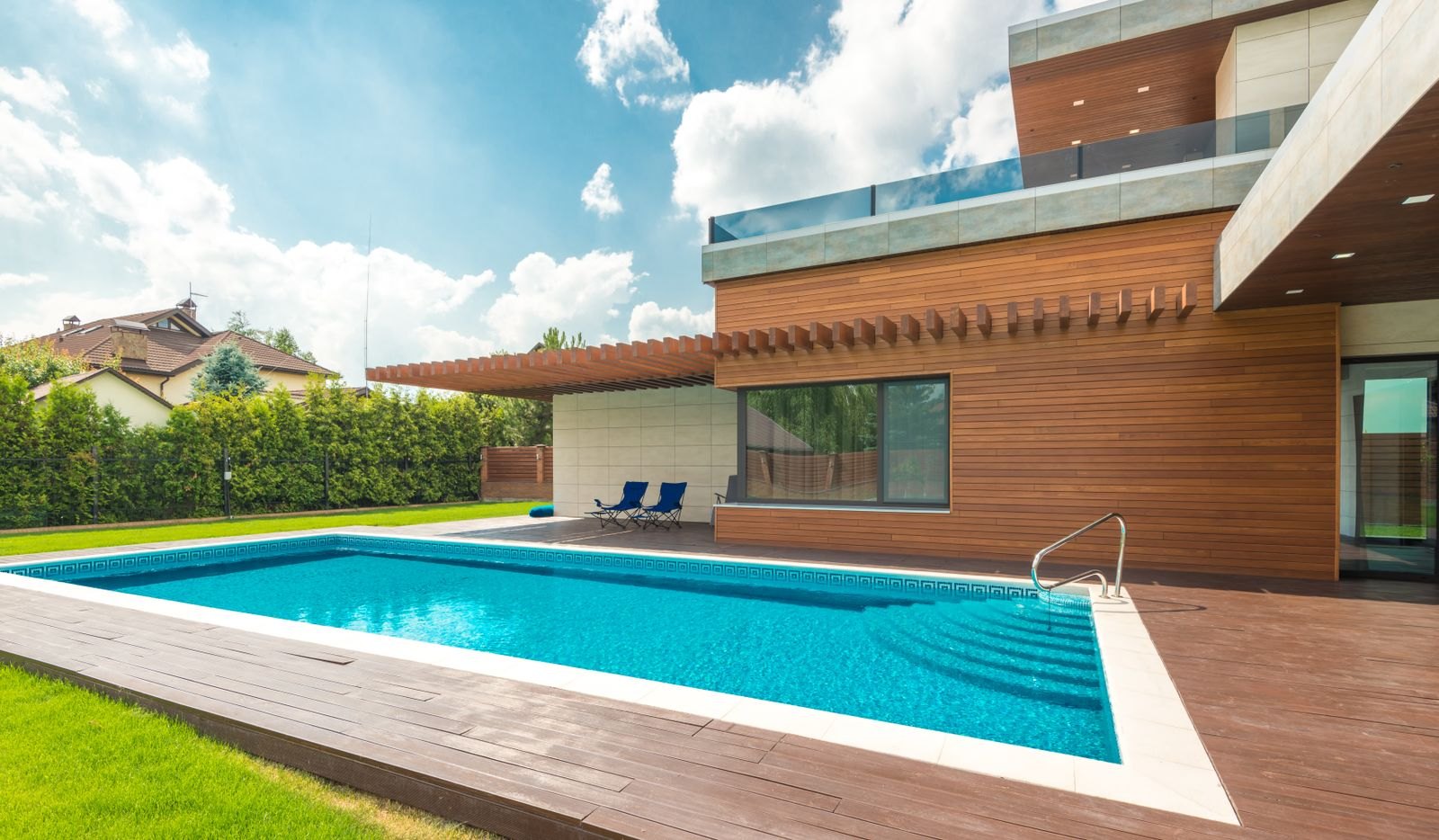
Coping and the joint between coping and deck
Coping is the cap along the pool's edge. River Pools prices it per linear foot:
| Coping | Per linear foot | 16×32 pool (96 ft) |
|---|---|---|
| Cantilevered concrete | $6–$15 | $600–$1,400 |
| Brick | $25–$30 | $2,400–$2,900 |
| Pavers | $40–$50 | $3,800–$4,800 |
| Travertine or natural stone | $40–$60 | $3,800–$5,800 |
Between the coping and the deck is a flexible joint, usually filled with mastic. The pool code (ISPSC 306.7) requires that joint to be watertight. When it fails, water gets under the deck and behind the coping, and St. Louis winters do the rest. Replacing mastic costs about $5–$15 per linear foot, roughly $500–$1,400 around a 16×32 pool, and it is the cheapest deck maintenance you can do.
Freeze-thaw and deicers
Freeze-thaw is what wears out St. Louis decks. St. Charles city and county list their weathering risk as severe in their adopted building codes. The National Ready Mixed Concrete Association's guidance for concrete exposed to freezing:
- Air-entrained concrete, about 6–7% air for severe exposure, and at least 3,500 psi (4,000 psi where deicers will be used). Ask for it on the quote.
- No deicing salt in the first year, and never fertilizers containing ammonium sulfate or ammonium nitrate, which attack concrete.
- A silane or siloxane penetrating sealer before the first winter.
For pavers, the Concrete Masonry and Hardscapes Association recommends rock salt and warns against magnesium chloride and CMA deicers. Keep the joints full of sand so the pavers stay locked together.
Saltwater pools and decks
Salt water splashed on a deck soaks in, dries, and leaves crystals that break up the surface. The American Society of Concrete Contractors says the damage typically starts at control joints and where the slab meets the pool coping. Its recommendation is a silane or siloxane sealer, or one topped with a solvent-based acrylic. Professional concrete sealing costs about $1.20–$1.75 per sq ft, every 2 to 3 years. On a 768 sq ft deck that is roughly $900–$1,350 a visit. If you are adding a salt system, budget for sealing from day one.
Slope, permits and setbacks
- Slope. The pool code limits deck slope to 1/2 inch per foot and requires a minimum, usually 1/8 inch per foot for textured concrete and pavers, so water runs away from the pool. Deck drains can stand in for slope.
- Permits. The City of St. Louis does not require a permit for paving with no roof over it, but a raised deck needs one. Under the model residential code, a raised deck is exempt only if it is 200 sq ft or less, no more than 30 inches high, freestanding and not serving an exit door.
- Setbacks. Town and Country keeps every part of the pool deck 20 feet from a lot line. Kirkwood requires 2 feet and caps accessory structures at 7% of the lot or 1,500 sq ft. St. Charles requires 5 feet. Check your city on the pool permits pages.
- Stormwater. MSD does not bill homes by paved area. Since 2024, residential stormwater funding has come through a property tax, so a bigger deck does not raise your sewer bill.
Questions to ask a deck contractor
- Is the concrete air-entrained, and what strength is it?
- What base goes under it, and how thick?
- What is the slope, and where does the water go?
- What is between the coping and the deck, and is it watertight?
- Is sealing included, and with what product?
- If I upgrade the whole deck, what credit do I get for the included concrete band?
Planning the pool and deck together?
The deck is the easiest place to blow a pool budget. Get matched with a local builder who can price the pool, coping and deck as one project.
Get matched with a local pool builder Use the pool cost calculator
Common questions about pool decks
How much does a pool deck cost in St. Louis?
Installed, broom-finish concrete runs about $6–$12 per sq ft, stamped concrete $9–$18, pavers $12–$25 and natural stone or travertine $15–$35. A 4-ft walk around a 16×32 pool is about 448 sq ft, so roughly $2,700–$5,400 in concrete or $5,400–$11,200 in pavers.
Is a pool deck included in the price of a pool?
Usually a narrow one. St. Louis turnkey pool prices typically include a concrete band about 3 feet wide around the pool, roughly 324 sq ft on a 16×32. A wider deck, a lounging area or a different material is an upgrade.
Are pavers or stamped concrete better around a pool in St. Louis?
Both work if they are built for freeze-thaw. Stamped concrete costs less but needs air-entrained concrete and a sealer, and a crack runs through the pattern. Pavers cost more, can be lifted and reset, and the paver industry recommends rock salt rather than magnesium chloride for deicing. No independent study we found shows one outlasting the other here.
What is the best deck for a saltwater pool?
Any deck can work if it is sealed. The American Society of Concrete Contractors says salt damage usually starts at control joints and where the slab meets the coping, and recommends a silane or siloxane penetrating sealer. Professional sealing runs about $1.20–$1.75 per sq ft every 2 to 3 years.
Which pool deck material stays coolest?
Color matters more than material. A side-by-side temperature test by River Pools found that the difference came from color rather than the material itself, so a light concrete or paver can be as cool as light stone.
Do I need a permit for a pool deck in St. Louis?
A flat concrete or paver deck often needs no separate permit, though it is usually part of the pool permit and must meet setbacks. A raised wood or composite deck generally needs a building permit unless it is small, low, freestanding and not serving an exit door.
Sources
- Block Renovation: St. Louis deck and patio costs (April 2026)
- St. Louis Stone & Brick: pool decks (2026)
- Unilock: designing an inground pool deck
- Concrete Network: pool deck cost (February 2026)
- River Pools: pool coping ideas and cost (August 2025)
- River Pools: how hot pool patios get
- ICC: 2024 ISPSC sample (decks, section 306)
- PoolResearch: replacing pool mastic (September 2024)
- NRMCA CIP 2: scaling concrete surfaces
- Concrete Masonry and Hardscapes Association: paver FAQ
- American Society of Concrete Contractors: saltwater pools (July 2024)
- Bob Vila: concrete cleaning and sealing costs (February 2023)
- City of St. Louis: residential permit criteria
- St. Louis Public Radio: voters approve MSD stormwater funding (April 2024)
Published October 27, 2026. Planning ranges, not quotes.